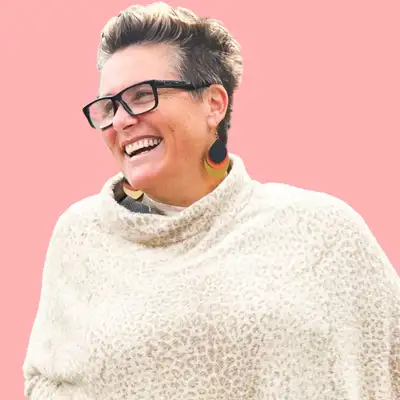
Community Based Midwives are the Anchor with Martha Redpath
MARTHA - Provider Space
===
[00:00:00] there is always this ability to find fear, whether it's fear in birth- Yeah ... fear in vulnerability, fear in stretching, fear in failure, fear in anything, and there also is that option to say, "What if I didn't fear? What if I led with my heart?
We are all so different. So for me to be using somatic things, to be doing some tapping things, to be doing breathwork with people, that's too weird for a lot of people. And I'll say, "This is who I am. This is what I do.
If it's not a right fit, please, no judgment. This is an investment of your time and energy. Find someone that you can feel that safety, that trust with,
a lot of community-based midwives who are CPMs will feel like they have to bend, and twist, and allow, and erase themselves in order to meet this birthing person's needs.
And they may intellectually be like, "No, I shouldn't do that," but in the moment, many of them will. And then they end up in a transport or with an irate client who's now- ... [00:01:00] suing them, and they're like, "I don't understand how this happened." And with coaching they'll be like- ... "Oh, I can see that actually I abandoned myself in this process."
I think this is the answer. This is the future. I think the community-based midwives are- Yeah ... going to be the anchor as we're seeing a dissolution of the bigger system. Community based midwives need to be- I love that ... in their strength and in their power because they are the answer for being able to practice when the grid goes out, if the grid goes out.
Martha, will you tell our listeners where you are in the world and how you ended up midwifing the midwife?
Yeah. So I live in Vermont in the United States, and have raised my three children and lived in the same home for many years, and the vision of midwifery happened as a teenager when I first went into nursing school thinking [00:02:00] do I wanna be a midwife?
I'm not sure." I went to Kentucky and got really inspired by that community-based program, and always had this sort of birth-death theme. So birth and death, and then I was, The pivot point for me was when I was pregnant, went to this low-risk OBGYN practice who was full, and I met this home birth midwife who halfway through the interview said, " You know I have a home birth practice, right?"
And I was like I didn't even know people did that anymore." And I turned to my husband, "You wanna have a baby at home?" And he said- I don't know, what's the big deal? And so that was that midwife, who was a British-trained midwife was that pivot point. I had been teaching childbirth classes. I had been doing visiting nursing out in rural Vermont for many years, and yet had no knowledge about home birth midwifery.
Then having my babies at home because I was a nurse, because I had newborn resuscitation skills, the home birth midwives would say, "Would you come be our seconds? Would you come be with us?" And I'd say, "Yeah, sure." And then I started getting calls [00:03:00] being, "Will you be the, my main midwife?" And I was like, "Ooh, I don't know.
I don't know." I had lots of experience. I had that, at that point now working in a small community hospital birthing center, but went back and did Frontier and became a nurse-midwife, thinking I was joining a home birth practice. And that home birth midwife, as compatible as we were, both CNMs, and philosophically approach at births, very hands-off, very gentle.
As a business partner, she was a train wreck for me. And it was really interesting to see that was the deal breaker. And this little birthing center where I had been working said we have a job here. Do you wanna join this?" And I had worked there as a nurse and knew that practice, and I thought, " Okay."
So small community hospital, small birthing center, did that for 10 years. It blew out. I opened another ho- nurse-midwife practice in another small community hospital close to me in Middlebury, who had never had midwives there. Very interesting, different dynamic than,
Middlebury, Vermont. Yeah.
Oh,
yeah.
Okay.
[00:04:00] Yeah. Okay ... and then after 10 years of that, it was merging. The hospital said, "Oh, no. We don't need this. It's too expensive," even though we weren't. And they were merging with the OBGYN practice, thinking midwives and doctors, they're the same, aren't they? And at that point I was like, "I'm 60, I'm done.
I really don't need to do this anymore." But since then, found coaching actually through alcohol as my burnout story-
Interesting. Interesting ...
went into more of a pattern where I was retiring, so why not have that extra glass of wine? Then it was COVID, why not finish that bottle of wine? And then getting really caught up in this, this is not good for me.
How do I... How did I get here? And here I meditate every day. I exercise every day, and I'm having a bottle of wine every night? This sucks. And so- Yeah ... found coaching, and that really was this pivot point where people were midwifing me And I thought, " Oh, this is my thread [00:05:00] again. This is the way."
Oh, that's so beautiful, Martha.
I love that.
Yeah. So nice. So it was interesting through that dark hole of alcohol that came into coaching m- midwives, women with alcohol, looking at that. But it morphed into also just burnout because many midwives are not at that point where they're drinking alcohol every night to cope- but they're feeling that edge of burnout. They're feeling that, their families are falling apart. They're just i- irritable. Yeah. They're losing compassion. They're maxed out.
Yeah.
And I thought if that is where I can capture people, and we have such a familiar language together- Yeah ... that it's easy to support and coach midwives because that's who I am.
And-
Yeah,
they're my people
too. And then the- Yeah, I get
it. Yeah. I get it. And the third piece is working with women now with grief, as I lost my husband a l- more than a year ago. And birth and death, those themes, so similar. And to have a death that was very [00:06:00] much like a home birth was quite extraordinary, and completely changed my perspective about what that can be.
So there are three little arms of this coaching business- I love it ... that I have. They're all very intertwined, aren't they?
Yeah. It's the threshold, right? Yeah. You're sitting at the threshold. Yeah. That's
right.
Oh, Martha, what a pleasure to have this conversation. I can't wait to get into the juiciness, and just gratitude for you walking this path, sharing this.
Midwives need what you have so badly.
Yes, I know. I know. And need you, and need the support. That's the thing. Yeah. Yeah,
they do. I'm gonna ask you a hard-hitting question right off the bat.
Go for it.
Do you think community-based birth is gonna survive this thing that's happening across the country of academicization and marginalization, criminalization?
The closing of all of the community birth centers, like- Are we gonna survive this?
I think we will. I think this is a microcosm of the macrocosm, right? I think the world is at this- ... tentative point in a lot of ways, and [00:07:00] midwifery has been through hard times before. We think that we're making this story up in a way because it's new for us.
But I think it's not a new story. It's a old historical story. But I think, actually, what I see happening is that as the small community hospitals are closing, birthing centers perhaps are cropping up. One of the first birthing centers in Vermont is starting because of one of the small community hospitals closing.
And the tertiary care centers are getting, midwives bar- bigger and bigger practices where the trust, the continuity, the, the value-based trust practice is diminishing. I think home birth is at this huge resurgence. I'm really excited about that. I think I've always been that bridge person- of those CNM... In general, people get their hats and their lanes, and they think, "My lane is the best lane." And I just, I've never really gotten that sense, and I think we- ... all need these diverse options for women to choose. But the options are getting diminished. Wow. All ecosystems need
diversity. That's right.
That's
how they
[00:08:00] survive.
That's right. That's right. Yeah. But I think we are. Yeah, what do you think? Do you think that we will survive?
I'm of two minds. I can see that we might have a real possibility, but I also... I'm quite afraid, especially as, the tech oligarchs try to march AI-assisted healthcare into our worlds, and certain things get normalized before they're tested or even understood.
Yeah.
I think midwives in the US are under a tremendous amount of strain and pressure.
I think they're having trouble even seeing a future. I think many of them are struggling to make enough money to feed their families. Inflation is crazy.
I think many of them- Are facing investigations, lawsuits patient complaints-
Right
board investigations, and now the new trend starting in Texas is to track and enter all public Facebook posts and Instagram posts in testimony against midwives.
Wow.
And so the midwives [00:09:00] need to police themselves even online in what they would consider safe spaces to just be like, "I don't know, what do I do?"
Because midwifery is not a straight line. Is really a level of pressure that's hard to come from.
Yeah.
Every single week, a new birth center closes in the US.
Yeah.
And more and more midwives leave the profession before they become senior midwives.
No, absolutely.
And I'm worried
I think all of that- I can see another path where, yes, the, the system dissolves and the beautiful flowers spring from the, from its compost, I would love to see that reality.
Yeah.
Yeah. But I think we're gonna go through a hellscape maybe before we get there, and I'm worried.
I think- Yeah
that's fair, and I think that fear is, is prevalent. And I do think that for me, the hope is in a I don't wanna sound too weird about this, but I do think it's on a higher
plane. You do sound weird.
Yeah. No. I- you're
welcome to be as... Go there. Yeah.
Yeah. No, I think it's on a higher plane.
I [00:10:00] think that there is always this this ability to find fear, and whether it's fear in birth- Yeah ... fear in vulnerability, fear in stretching, fear in failure, fear in anything, and there also is that option to say, "What if I didn't fear? What if I led with my heart? What if..." You have to get savvy. I don't mean that you can be Pollyanna-ish, but I think that there is a way to still operate, and I think what you're doing with your training, getting people smart about legal action, getting them smart about- no, you can't put it on Facebook. I lived in a war zone. I lived in Beirut in '82, '83.
Wow. Wow. There were no expectation of freedom of speech.
Everybody knew that there was somebody listening, that there was somebody threatening- ... that there was a tentativeness- ... to everyday life, and in that midst- ... of everyday tentative life, there was also this extraordinary heart that stepped forward- ... [00:11:00] with goodness, with kindness, with giving to those very people that perhaps had just slaughtered your family literally.
And so that experience has let me realize that we're cushy in our country. We we moan and groan about, "Oh my God, I can't put this on Facebook," and, "Oh my God I'm struggling," and, "Oh my God." Most of the world is struggling with this, and I think it's finally hitting us that we may- Yeah
have dramatic changes to how we have lived, but what's really- Yeah ... gonna count is do we lead with our heart or do we lead with fear? And it... I hate to sound simplistic, but I really do see it as that simple. There are always gonna be people that say can't do it. Too afraid. Close down. I'm done."
And there are always those people that just show up and say I'll catch your baby, and, I'll do what I can." And that's a strong, old story- Yeah ... of women that have just showed up in ways- Wow ... that regardless of all the external circumstances, I think That's what we're called to [00:12:00] do,
you
know?
It's not easy. It's not easy, and I think it does get harder and harder
From your mouth. Let's make this real. As more and more of those women do just show up I hope the matriarchy is rising. I hope that we do see the transition in our lifetime. There have been some experiences in the recent past that have dramatically impacted home birth rates.
I think you were in practice when Ricki Lake's documentary came out. Do you remember that big- ... bump in calls- yeah ... after that in, I think it was- Yeah ... 20- 2010. Tw- 2007, I think it was, is when there was this- Yeah ... big spike. I think from that movie alone the home birth rates rose 30%. And then we had, the Affordable Care Act changed a lot of home birth rates for a lot of people.
And then we had COVID, and every year of COVID, the home birth rate went up 30% nationally.
And internationally
too, I think- And now we're sitting at 1.9... And internationally too, for sure. Yeah.
Yeah.
Now we're sitting at 1.9 and in some [00:13:00] western states, there's about 9 or 10 western states that have crossed critical mass, 3.14%.
And so that's happening faster than I originally had anticipated, which is-
...
Very exciting. And it does get exponential at the end, right? That thing that was- ... was ridiculed then becomes self-evident. And so I really hope to see that happen quickly.
And- Are you- ... I Vermont has been consistently 2%, twice the national average, right?
But, Yep. Yep ... and when you're in that circle, it seems like everybody's having their babies at home. And of course they're not. I think Vermont is in the, I don't know, 15% of the births are midwife-attended births. Wow. Higher than many, but still low comparatively.
Rightly or wrongly, it means that 98% of the women are choosing to have their babies in the hospital. And how can we empower the systems that are so broken now? How can we empower the women to be their best advocates? 'Cause I do still think that's where the change happens. I think that it is the women-
Agreed
[00:14:00] being educated and saying, "No, I really don't wanna be induced." Or... and al- also up to the midwives to say, "This is my practice. These are my standards of care." And to be willing to say, "I'm sorry, I won't induce you at 38 weeks 'cause your mom is here and leaving town. I won't do that." And they'll leave.
Yeah. I've had that happen to me, and they left my practice. Yeah. And, you know- Yeah ... the administration went up in arms. And I said, "This is my value system." So part of, I think, the education piece as our- ... own providers sense, our own boundaries, is to say, " This is who I am. I am not all things for all people."
And some people are gonna feel more comfortable in this setting or with this person. Find the right fit. You only have a few babies, and you're gonna have the most congruence when- Yeah ... you have someone who's upfront about- y- my C-section rate is 10% because I do blah, blah, blah, blah, blah. And if you want higher s- choice to have the C-section planned, that is your choice.
There are plenty of providers who will do that. It was such a [00:15:00] shocking thing for me to even think that women were advocating for that, but that was their value system and not my value system. So my job was to define my own self, my own practice, be absolutely upfront with people, and at the very beginning say, " You find the right fit.
Here's how I am. This is what I do." And the same thing with coaching. We are all so different. So for me to be using somatic things, to be doing some tapping things, to be doing breathwork with people, that's too weird for a lot of people. And I'll say, "This is who I am. This is what I do.
If it's not a right fit, please, no judgment. This is an investment of your time and energy. Find someone that you can feel that safety, that trust with, that sense of- I get this person, so I don't know. How do you feel about- Part of it's a great- ... that with your... How do you do that with your as you are practicing and presenting your own practice and teaching, how are you presenting that to the midwives- Yeah
in there?
Foundational to my teaching is really boundaries work, and I think that's what you're [00:16:00] demonstrating so well is to be an effective midwife, to communicate effectively, you have to identify and m- and live your boundaries so clearly. Yeah. And I would say this is a distinction that I've s- noticed over the many years I've been doing this is the entry to community-based birth from CNM pathway is so better boundaried than the entry to community-based midwifery from the CPM pathway.
And I wonder if you would reflect on your mentors, your education, the messaging that you got. How do you feel like you got so boundaried from the beginning? How do you feel like you could just trust and reflect, and express your limits so clearly? Because a lot of community-based midwives who are CPMs will feel like they have to bend, and twist, and allow, and erase themselves in order to meet this birthing person's needs.
And they may intellectually be like, "No, I shouldn't do that," but in the moment, many of them will. And then they end up in a transport or with an irate client [00:17:00] who's now- ... suing them, and they're like, "I don't understand how this happened." And with coaching they'll be like- ... "Oh, I can see that actually I abandoned myself in this process."
But they don't see it in the moment. And I'm wondering can you identify what got you so boundaried so early on so that you could allow a client to leave even angry and be like, "That's okay. This is acceptable"? How did that happen for you?
Yeah I think midwifery skills come from our midwifery heart from who we are.
I think that we, each experience we draw from. And I think... I can't say exactly what created that. I know that I had enough home birth- experience to choose a school that supported non-intervention birth. So that was one... That was a boundary that I had to find. I applied to the... I looked at these different schools and they were...
I was like, " What?" "Why would I do that?"
It was so medically model driven. Great service to many people, not my thing. And so I think it was just a lot of [00:18:00] clarifying what was my gift, what was my skill, what's my lane that I could stay in? And I did some advocacy work. I was... vermont is small, so the ACNM, you have to get political in some degree, but it wasn't my thing.
I really wanted to keep it small. And the, the practice was anywhere from 6 to maybe 15 births a month. It had a lot of autonomy and respect. We had to fight for it, and I had to then i- create that with this new place that had never had midwives before. But I knew who I was as a midwife, that I could intervention...
i... That's a really interesting question, and I'm not quite sure how to answer it. I don't know how those boundaries were created, but I think as a- Well- ... midwives in general-
It's impressive
It's I think part of that is collegial support, to have people- ... to bounce ideas off of. I think that's really crucial, and I think we get isolated in rural areas, particularly in home settings.
We... [00:19:00] And there's more competition rather than college. It... And that, that just makes me crazy. So that was a lot of bridge- ... building work that I would try to do to debrief after births because we became the transfer hospital for the home birth midwives.
Oh, interesting ...
and so how to create connections of respectful care rather than blame, shame, any of that.
So I think a lot of it is the cultural context because it's really hard to have that cultural context in a huge system. The big tertiary care center- ... that was not true. Even transferring from small community hospital to there, there was a lot of shaming, a lot of blaming, a lot of disrespectful contact that was like, "Oh, really?
Fuck you," that you wanted to say, didn't. Bubble head action. But it's I, I'm a trained- We should just- ... knowledgeable person
We should just start saying it. Start saying it like that.
Martha Fr- Just- You just teach a, you should teach a class, like how to swear at your transferring physician, piece of dick.
Yeah. And see if that'll really help. Probably not. Probably
not. We've tried everything else.
[00:20:00] Oh, gosh.
Sorry.
No, it's
okay. So that was my thought bubble. Go ahead. Go ahead.
Yeah. That's okay. Bubble heads are a wonderful thing. I don't know, Augustine, but I do think- ... having boundaries is really important, and I think it's-
Yeah, it's extraordinarily important, and you have it.
I heard it in your language. It was clear, it was so kind, the example of a client who's really wants something you can't offer. So clear and beautiful, and yet it is a lot struggle. And it's been the, it's been the cornerstone of my teaching-
Yeah ...
since I started 10, 15 years ago, is helping midwives come into themselves, identify their legal, professional, personal boundaries- Yeah
and then find the language to describe that. And there's a quote that I've repeated 1,000 times to myself and others to learn this is "We have to be okay disappointing others in order to stay on our own path." I have- Absolutely ... to be okay with them being disappointed, absolutely. And that's what you demonstrated so well just a few minutes ago. This person deeply [00:21:00] disappointed, the hospital deeply disappointed in the loss of a client, and you still, "Nope, this is how I practice within my scope and my morals." And that is such a beautiful demonstration, and I would say if there's one thing I hope I'm known for, it's helping to bring this awareness of not only the need for boundaries, but the right of all of us to practice within our scope and within what makes us comfortable.
We do That's right ... not have to shrink to fit or expand unnecessarily. We have the right to practice safely within- ... what we define as that,
that's right.
I, that's what I hope.
That's right. Yeah. And I think the, the most- Yeah ... dangerous midwives that I know are those that try to be all things to all people.
And I think that they're- Oof ... those are the ones that do things they shouldn't be doing, also don't do things that they should be doing. And so they're second-guessing so much that they're bending over backwards to accommodate someone like somebody who will say I don't want anyone to listen to [00:22:00] my baby at all."
W- And I'm saying am I... I'm sorry, that's not, that that's not quality care for me. And if you wanna have a completely unattended birth by yourself I will support you, and I will give care for you." And I will talk to you about that risk-benefit." "And I will bless you. I will think of... but I cannot attend that birth."
So- ... I think that the students that I've had, that, the, it's that listening to the voice, and the ones that will, To go because they say, "Oh, but she wanted that, and so I should go there." It's like, no, you call in your sister midwife who's done 100 breech births, and you call them in, and you're humble.
You're not saying, "I could do that. I learned it in school."
Yeah, exactly.
Hi guys. Let me just interrupt this podcast really quickly to tell you about one of my favorite new products. This is the Student Midwife's Keepsake Journal. My team and I worked long and hard on [00:23:00] this beautiful documentation tool. If you are a student and you are still working through your numbers, this beautiful book is gonna give you an opportunity to track your stats as you learn and this will be a keepsake journal that you can look back on for years to come.
Also, I really wanna point out that this is the only journal on the market that is HIPAA appropriate. Many journals ask you to write down names, places, dates, and that is all HIPAA violation. And even as a student, you are responsible and triable and fineable for violating HIPAA. So this document in the very beginning of the book shows you how to stay HIPAA compliant even as a student, and nothing in this journal would allow you to violate patient safety, patient confidentiality, or violate those national rules.
We also have a number of reflective points, prompts, and space under each birth to [00:24:00] journal about them. This book has space for one hundred birth records so that you can get through no matter what course you're doing, what class you're doing, there is space for all your births in this beautiful journal.
It is for sale on our website and on Amazon, and we'll link it below in the show notes, and I really hope you pick up a copy. Now back to the show
I love it. You understand it so clearly, and I guess I'm still hurting for the midwives that don't understand it so clearly.
Yeah.
And still working to try to shine that light because it makes the difference in not only safety-
Yes ...
personal safety, professional safety, but it also makes the difference in fulfillment.
Yes.
In, in feeling like you're walking your path and not like you're codependently serving everyone else's needs and ignoring your own.
It's a personal growth place to be like- That's
right ... "
That's outside my scope. I'm not interested. No, thank you." Like that's such an important thing. I've been [00:25:00] on that curve, and I've noticed- Yeah ... so many of my colleagues also. We did not enter midwifery with any concept that we could be boundaried.
Our preceptors, the culture around community based midwifery is very much martyrdom. Give until you have nothing left to give. Stay up all night. Do it yourself. It's very much the lone cowboy reality. And I hope that we change that, I hope we change that.
And I grew up in that as well.
Yeah, nervous system
regulation.
Yeah. Yeah. Yeah. And I-
Yes ...
I was shocked by the younger midwives coming in and saying th- that they wouldn't do that bec- I was always in a one, two, or three midwife practice. And we absolutely encouraged each other to take two weeks off at least every s- every year.
Not just one- ... because two gives you more space.
But it means that you suck it up when someone else is doing it, and don't complain. There was a certain amount of expectation of you just show up whether it's easy or not. So that martyrdom piece was there, and the newer [00:26:00] ones came in, and it took me some adjusting to say, " Wow, this is too much for you to be on call this much?
This is just our life, isn't it?" And they were setting up more boundaries like, "No, I gotta this off, I got this off, I got this." I'm like, " Wow, this is a whole different way of thinking." So and there are pros and cons to it. I do think again, there's a bit of entitlement, I think, that comes in that
the older providers- It's a line, right? It's a line. It's a line. There's a line. Yeah. But I do think we all have our different lines. Yeah. And so to be in a practice where you're on call by yourself for one year, two years, five years, maybe that's not self-sustaining. So you learn, bring in a partner. Have people share call with you. How do you make it sustainable so your family's not falling apart every time you get home? Don't have as many clients.
Yeah.
Take a summer off. I've seen different models, but isn't it at the question of what do I need? How can I meet that need?
Yeah. We're not taught how to do that as women
And then what I keep banging is there's a question beneath that, which is I'm allowed to [00:27:00] have needs.
Yes. Yes. Yes. The worthiness.
The worthy
part
The, the self-worth conversation, yeah, that comes in before you even understand the boundary setting.
The common theme, the common denominator that I feel like I've identified in community-based midwives at least in the CPM pathway is that all of us come from pretty dysfunctional families of origin, and that's how we learn to accept the level of dysfunction that midwifery provides.
And, yeah I bet that's partly true. And-
That who else would live with this kind of crazy demand? Those of us who grew up doing that, we're like, "Oh, this is normal," and it's not actually normal.
Yeah. Yeah. But isn't it true that the dysfunction can create our strengths? And so that
willingness- Oh, absolutely.
It's also our superpower.
Yes. I
mean... Oh, yes. Yes. Yes. Yes. That willingness to show up, to support to feel into the energies of the space, [00:28:00] to adjust and... it's extraordinary. I mean- Yeah ... home birth midwives are some of the most sensitive people, most energetically sensitive people. They're witches, right?
They can, like- Yeah ... move time and space and-
Yes
Yes, 100%. Yes. And yet we are the victim of that superpower by giving it always away- And I- ... and not-
And there's a gift- ... taking care of ourselves. Yeah ... ab- oh, 100%. So my whole belief is that the difficulties, the conflict, the struggles are the very same coin that create the strengths.
And once we can- ... see both, not e- get rid of or eliminate the struggle piece, the pain part, the, the messiness, but to embrace that, then it's integrated. So to, to be aware of, "I just totally fell apart when I got home when the dishes weren't done and my family's, my kids are a wreck. Oh, [00:29:00] okay."
To be aware of that. How could I do this differently? Do I have to bring my newborn who's nursing and let them scream when... 'cause somebody's pushing? And oh, my God, what am I doing? Why am I doing that? And we've all been in those sp- in those moments- Yeah ... where we're sacrificing so much at our own expense.
And I think too much of that you begin to question- something's gotta give here.
Yeah.
Yeah. That
is, that unsustainability leads to burnout. That is- Yes ... the pathway right there.
Yes.
Yeah.
Yes.
So Martha, you are now helping folks who got there.
Yeah.
And will you tell us a little bit about your coaching practice and what it looks like to midwife the midwife for you?
It is still that strengths-based focus. So people will come to me and say, "I'm burnt out. I'm losing my interest. I don't know whether I should stay or go. I don't know if I should bring a practice or not." And we just start exploring if you look at different aspects of your life, a piece of the pie.
How are you spiritually? [00:30:00] How are you financially? How are you relationship wise? Sort of eight different directions. And people fill that in, and I ask them, "What's the first thing you look at?" Nine times out of 10, actually 10 times out of 10, I would say, people look at their most troubled, problematic place, their weakest point, their critical voice, their, "This is so fucked up.
I'm so fucked up. What's wrong with me?" And rather than, "Okay let's focus on this part of your life that is so strong. Why is it strong? What is... What parts of yourself do you bring into that?" And so I think, again, it's what we do with women with midwifery. When they come into your office, you're not focusing on their dysfunctional habits.
You're focusing on what they're presenting to the table that is their beauty, their strength, their... So it's that, and it's helping people notice that negative voice in their heads, for sure. Is that true? Does she have to... can there be an acceptance of that negative voice, but [00:31:00] not let her drive the bus?
And A- and the regulating, the how to get your nervous system in alignment. When was the last time you actually felt safe? When was the last time you actually felt in your body, grounded, comfortable, at ease? And how can you operate in the world at ease a little bit more? And so it's like the tiny habit thing.
It's not the whole big picture. It's building those little, teeny-tiny habits into our lives that you can hang onto, that you can notice, and it builds on itself. And so- ... you can call it gratitude. You can call it awe. You can call it love. You can call it anything, those little snippets that are like- Soul feeding.
And those are the, so that's the homework. Or we just take a pause, put on music. Okay, list everything today that happened to you that was so beautiful. I don't know nothing. Just think about it. Oh, yeah. Oh, yeah. Oh, yeah. And it transforms our beings when we're focusing on that. And then you also say, "Okay, what's the worst that happened today?
[00:32:00] How'd you feel? How do you wanna feel? What's leading into that? How can you live with that, accept that?" Because we push away the pain, and I Pam McChutnen calls it the discomfort resilience. I love that. So how can we as midwives- ... as human beings become able to hold our own pain in a way that's not dysfunctional holds it with also the delightful things that we do, and I think that's where the sense of calm comes, sense of balance comes.
I don't know. What about you? What do you find? What for you today has worked? What are the delightful- Oh, I love that ... moments for you? What are the snippets for you?
Yeah. You've got it. It's a great listening to you. I agree. I think that looking at both sides of the coin, not pushing away the pain, but bringing in the glimmers as they call them, right?
Instead of triggers, we have glimmers and
Yeah ...
focusing on that, that gratitude practice, that awareness, like, where attention goes, energy flows, right? Like- Yeah ... we need to have that awareness in midwifery, too. For me, I feel [00:33:00] like I'm still working on it myself. I don't do a ton of nervous system regulation with my clients because I'm still working on it myself.
I don't feel like an expert in this space. That's why I love talking to people like you and Christie Davis, who's a co-teacher with me and those of you who have made this your life path. But for myself, I would say everything you described, definitely. And I also find great strength in feet on the ground, face to the sky, you know- Yeah
just real immersion in nature to reset.
Yeah.
I'm a horse woman, and so getting back on horseback- Ah, cool ... has been a
wonderful-
tool for me. Yeah. I sailed around the world last year and being in the negative ions of the ocean for a whole year was, like, deeply healing for me, so- Oh, I can imagine
I really, I think that nature immersion is a huge healing component that midwives sometimes, we're so busy we forget to just slow down and touch the ground.
That's right. That's
right. So that's been powerful. And I would say a newly learned skill that has been really [00:34:00] powerful is finding one person that's truly safe and- Yeah
understands the stress of midwifery the very unique quality of the needing to be on all the time, and yet also the need to let down. That kind of a confidant. Yeah. Finding that person and then just practicing-
Yeah ...
vulnerability and sharing.
Yeah.
Yeah ... that's been a really powerful thing for me is,
What a gift.
Yeah.
Yeah. It's such a gift. And, And there, there aren't very many. Brene Brown calls them your move the body friends, or
...
Or your marble jar friends. You're really blessed if you have two or three of these people in your life.
One is enough. Someone who can can hear you say, " I don't wanna discuss this, and I don't really want feedback. I just wanna be heard right now. I just wanna tell you- Yeah ... what happened." And they can just make space for that.
Yeah.
I know.
Yeah ... and you know you won't be judged. If you can find that person, that's really special.
It is really special. Yeah. And I think-
Yeah ...
it brings you back to your authentic self, right? You can be [00:35:00] honest, you can be real, you can be messy. Yeah. You can be you can see that you are a whole, W-H-O-L-E. Yeah. That whole person thing.
Even though you
might
feel like a H-O-E.
That's right.
Love that.
That's right. You
might feel they're... no, what a gift that is. What a gift that is, and I think that's ideally what we can hold for each other. And that, it-
Yeah ...
h- having that myself has brought me... So my coaching colleagues in my training program have been those safe people, and I have had other relationships, of course, too.
But to learn how to be vulnerable, how to be messy, how to be sharing those deep, painful moments with those weeping tears is very freeing and beautiful. And if we can allow that it opens our hearts. It's compassion for other people because we're compassion for ourselves. And, ugh, that's what you hope for.
Yeah.
Yeah.
Yeah. That's beautiful. And if you don't have that person [00:36:00] yet, you can do it for yourself literally because- Yes ... these tender parts of ourselves just need to be heard. And so even if you just have a practice where you sit for a lone journal, sit in front of a mirror, tell yourself the story.
You can hear it in a different way. You can hold yourself in a different way. The worst and most damaging thing in life, in midwifery- is to hide it away. Yeah. Shame grows in silence.
Yes. Yes.
Absolutely. Absolutely. Yeah. And we all have those negative voices- Yeah ... that are really loud and really, very skillful at coming in, and to be able to notice that and find a way to be kind to her,
yeah.
Self-kindness.
Yeah. That, that practicing. Yeah. Martha, people can work with you, right? If they're feeling- Yeah ... like they're at this place of burnout and they don't know what to do next. Yeah. How do they get in touch with you? How do they work with you?
So my website is providerspacecoaching.com.
They can just email me, and we can see where it goes from there. And I do [00:37:00] sliding fee scales so that everyone can be included, and money is not an object. And whether it is just needing that safe space, maybe it's a one-off that they just call and say, "Go, I just need to debrief with you." I'm like, "Okay."
Or, "I've got a lawsuit coming on and you're a safe person, I can debrief this with you." And I'm like, "Okay." And I have a six-week package which is around burnout. We actually have this beautiful book called The Big Life Journal, if you haven't seen it. It's very brilliant about are you operating from lack or are you out of abundance?
Are you... Is that critical voice getting? Is, how are you practicing gratitude? All these sort of practical skills. And that's a lovely sort of workbook that I use. But sometimes people just make it up as we go. We use that as the template, and then half the people don't even do the workbook, and so we end up just- Working with whatever is in front of us
midwives So, that's right.
They're really bad with homework.
That's right. We're all too busy. We're all too busy.
They're onto the next. [00:38:00] Onto the- That's
right.
Yeah,
exactly.
That's right. So beautiful, Martha, and so grateful that you're adding to community-based midwives and supporting them.
I feel so drawn to you and Lesley Cromwell and Christie Davis and, the handful of us who have come around to support this community. It just, it's so meaningful to connect with you and to be in this space with you. It's so meaningful, and I'm just so grateful.
Yeah. I'm so grateful for you for all the work that you're doing in building these community-based midwives that it's...
I think this is the answer. This is the future. I think the community-based midwives are- Yeah ... going to be the anchor as we're seeing a dissolution of the bigger system. Community based midwives need to be- I love that ... in their strength and in their power because they are the answer for being able to practice when the grid goes out, if the grid goes out.
I just think who knows where our world is gonna go, but the community-based midwives will know- ... because they're used to operating- Yeah ... in a world that is [00:39:00] based on what's in front of them, not technology-driven. Yeah. So I am- Yeah ... wholeheartedly-
Yep ...
in support of it, and I'm grateful that you're building it up-
Me too
on so
many levels.
Me too. Me too. Yeah. Me too. Yeah. Let's let's create this- Let's keep in
touch ...
strong foundation so that- Yeah. Yeah. Let's... Please, I would love that. Thank you so much for this. And if I can support
you
in
any way if I can, yeah, support your students in any way, just we can be flowing together, my dear.
Awesome. You will definitely hear from me. Thanks, Martha. Great. I appreciate this so much. Yeah,
thanks. Yeah. Have a great time.